Deutsch | English
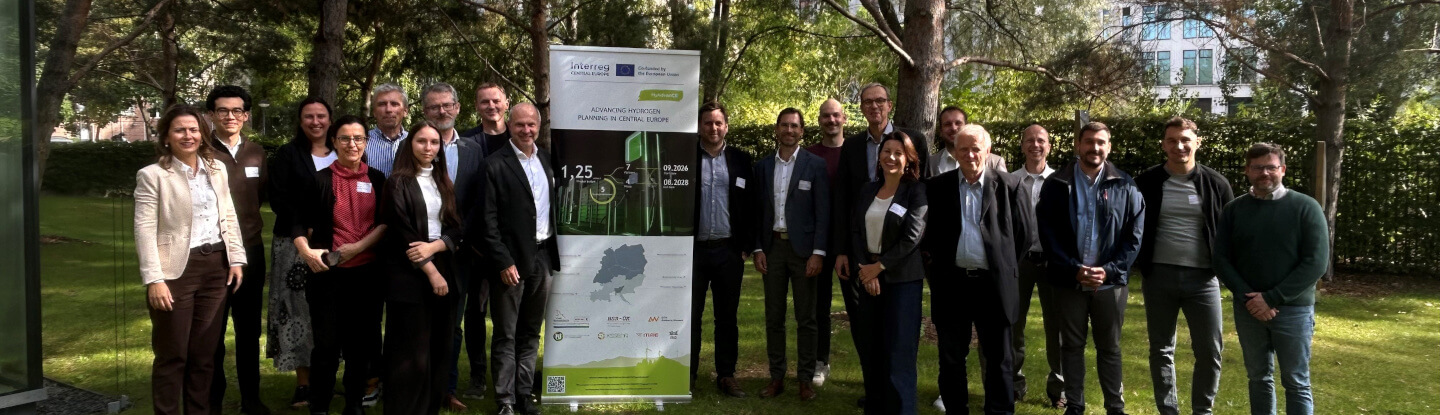
The Joint Spatial Planning Department Berlin-Brandenburg (JSPD) initiated the European cooperation project HyAdvanCE – Advancing Hydrogen Planning in Central Europe and is responsible for its overall coordination as Lead Partner. The project aims to strengthen the integration of the emerging hydrogen economy into spatial and regional planning, with particular attention to cross-border interdependencies.
HyAdvanCE is funded under the Interreg CENTRAL EUROPE 2021–2027 programme. The project runs from September 2026 to August 2028 and is implemented by seven project partners from Germany, Poland, Czechia, Slovakia and Slovenia. The project budget amounts to approximately EUR 1.21 million; 80 percent is co-financed by the European Regional Development Fund (ERDF).
HyAdvanCE was selected under the fourth Interreg CENTRAL EUROPE call, which focused on capitalisation. This approach aims to strengthen links between the results of previously funded projects, apply them in new territorial and thematic contexts and extend their use beyond the original projects.
For this purpose, HyAdvanCE builds on results from several European hydrogen projects. These include H2CE and HyEfRE from Interreg CENTRAL EUROPE as well as H2GreenFUTURE, HyBaBo and H2MA from other European cooperation programmes. Existing strategies, methods and tools are brought together, adapted to new territorial conditions and tested in practice. The experience gained through their application is then fed back into strategic and transferable project results.
Renewable energy potential, hydrogen production, transport infrastructure and future hydrogen demand are part of spatial systems that extend across administrative and national borders. Planning, responsibilities and strategic frameworks, however, are still predominantly organised at national or regional level. Particularly in border regions, there is therefore a need for stronger coordination of spatial and energy-related developments.
HyAdvanCE addresses this challenge by testing different approaches to cross-border hydrogen planning in four pilot areas. The experience gained from the pilot activities will be used to develop strategic documents and transferable solutions.
A key project result will be a Hydrogen Planning Guidance. It will provide a methodological and practice-oriented framework for public authorities and regional stakeholders to consider hydrogen production, infrastructure and demand in cross-border spatial contexts and to support corresponding planning processes.
HyAdvanCE builds on the work of JSPD in the predecessor project H2CE – Empowering H2-ready regions in Central Europe. H2CE developed approaches for strengthening the integration of hydrogen into spatial and regional planning. HyAdvanCE continues this work with a stronger focus on cross-border planning processes.
Coordinating spatial development across administrative boundaries is one of the core tasks of Joint Spatial Planning. At the same time, the development of a hydrogen economy is creating new energy infrastructure, land-use requirements and spatial relationships between production, transport and use. JSPD therefore contributes its experience in spatial planning and transnational cooperation to the project.
JSPD’s role as Lead Partner enables it to build on the experience gained in H2CE, link the results of different European hydrogen projects and apply the approaches developed in a cross-border area of direct relevance to Berlin and Brandenburg.
For JSPD, a particular focus is cooperation in the East Brandenburg–Western Pomerania area. A German-Polish pilot will examine how the development of the hydrogen economy on both sides of the border can be better coordinated and integrated into spatial planning processes.
Existing plans and activities, as well as information on renewable energy potential, hydrogen production and use and relevant infrastructure, will be brought together. Existing stakeholder and cooperation structures in the border region will also be involved. On the Brandenburg side, participants include the Uckermark-Barnim Regional Planning Association, Kreiswerke Barnim as the organisation responsible for the Barnim-Uckermark Hydrogen Region, as well as the East Brandenburg Chamber of Industry and Commerce (IHK Ostbrandenburg).
Based on the pilot activities, a cross-border planning approach for East Brandenburg and Western Pomerania will be developed and translated into a strategic document for further German-Polish cooperation in the hydrogen sector. The results will also feed into the transferable planning approaches of the overall project.
The experience gained in the four pilot areas will be compiled and made available for use by other regions in Central Europe. In addition to the Hydrogen Planning Guidance, the project will develop strategic and practice-oriented solutions for cross-border hydrogen planning.
The H2CE Collaboration Platform, developed under the predecessor project H2CE, will also be upgraded. It will bring together the project results and support the exchange of experience between regions, public authorities and other stakeholders.
Interreg CENTRAL EUROPE project website: HyAdvanCE – Advancing Hydrogen Planning in Central Europe