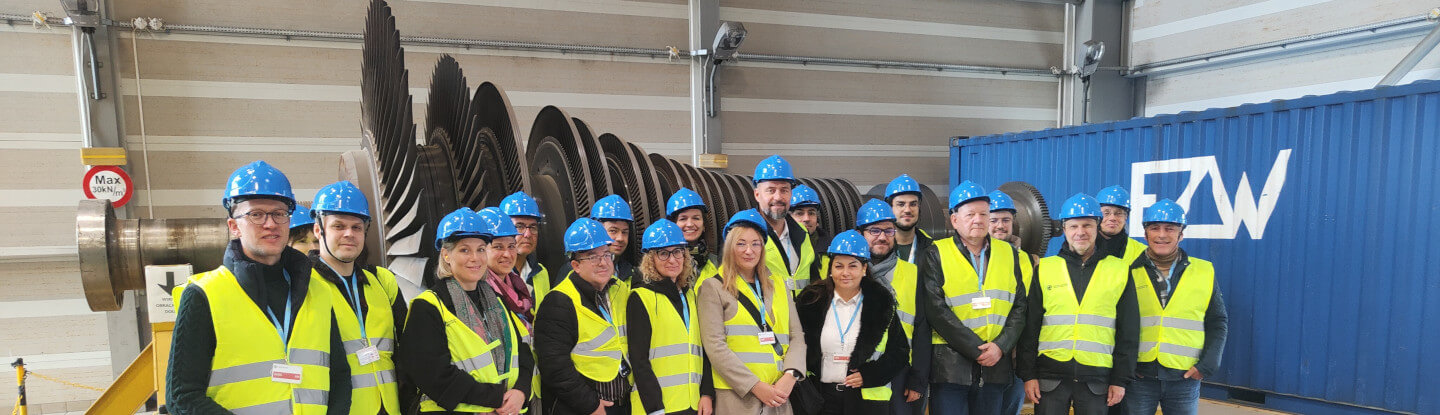
Between 14 and 17 October 2025, administrative staff from the Federal States of Brandenburg and Berlin and the cities of Frankfurt (Oder) and Cottbus, together with administrative staff from the Lubuskie Voivodeship, travelled to Zielona Góra and Warsaw to learn about spatial development issues in connection with urban planning, energy and transport. This was the second fact-finding trip as part of the ‚BB-L Interconnection. Vision for a joint interconnection area“ project, which aims to deepen the professional exchange between institutions and regions in the long term.
The aim of the trip was to learn about current developments and strategic projects in the Lubuskie Voivodeship and Poland as a whole, and to gain a better understanding of the Polish spatial planning and administration system by looking at practical examples and meeting with representatives from the municipal, regional and national levels.
Anna Chinalska, member of the Lubuskie Voivodeship Executive Board, welcomed the guests to the Marshal’s Office and emphasised the contribution of the BB-L Interconnection project to establishing lasting cross-border cooperation and strengthening institutional capacities in the region. Cezary Wysocki, Deputy Director of the Department of Geodesy, Real Estate Management and Spatial Planning, outlined the project’s implementation status, and Dr Magdalena Balak-Hryńkiewicz, Deputy Director of the Department of Economy and Development, presented the Lubuskie Voivodeship’s 2030 development strategy, highlighting the synergies between regional measures and the objectives of the BB-L Interconnection project.
Participants then visited the town hall to learn about land use planning in the city of Zielona Góra. Małgorzata Maśko Horyza, Director of the Department of Urban Development – Urban Development, and her team presented the so-called ‘General Plan’ (Plan Ogólny) currently being drawn up, which is a new planning instrument comparable to the German land use plan and which all municipalities in Poland must prepare by 30 June 2026 at the latest. They also gave an overview of the revitalisation of deprived areas in the city of Zielona Góra as part of the revitalisation plan. During a tour of the city centre, the group gained their own impression of these areas around Plac Słowiański, Plac Teatralny and the Palm House. The day ended with a joint dinner followed by an inclusive bowling session at the Grape Town Hotel.
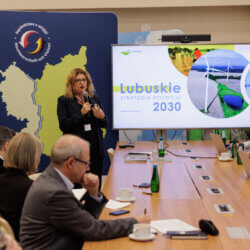 Presentation of the development strategy for the Lubuskie Voivodeship 2030. Image: Marshal’s Office of Lubuskie VoivodeshipBild: Marshal’s Office of Lubuskie Voivodeship
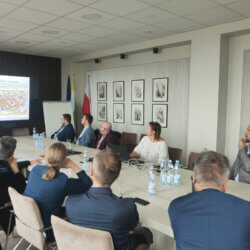 Presentation on land use planning at the City of Zielona Góra. Image: Marshal’s Office of Lubuskie VoivodeshipBild: Marshal’s Office of Lubuskie Voivodeship
The tour of the combined heat and power plant in Zielona Góra was the first item on the agenda on the second day. After a short presentation on the importance of the energy supplier for the municipal heat supply in Zielona Góra and the surrounding region, the technical manager gave the group a tour of the power plant and vividly explained how it works. Back at the Marshal’s Office, two representatives from the General Directorate for National Roads and Motorways and the Road Construction Authority in Zielona Góra provided an insight into road construction investments in the Lubuskie Voivodeship. In the afternoon, the group travelled to Warsaw.
In Warsaw, after a guided tour of revitalised areas in the Praga district, a visit to the Sejm was on the agenda on 16 October 2025. Here, the group had the opportunity to talk to a representative of the Infrastructure Committee, which was meeting that day alongside many other committees, as well to members of parliament from the Lubuskie region.
On the final day of the fact-finding trip, the group visited the Ministry of Development and Technology, where Mr Łukasz Marciniak, Deputy Director of the Spatial Planning Department, presented an overview of the Polish spatial planning system. Following this, employees from the Ministry of Funds and Regional Policy outlined the concept adopted in 2025 for the development of the country until 2050, as well as the model for the functional and spatial structure.
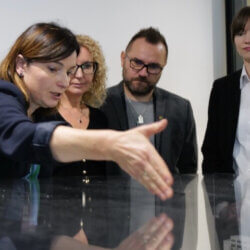 Guided tour of the Sejm.Bild: Frank Amey
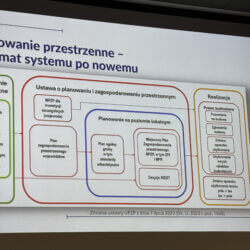 Schematic overview of Poland’s spatial planning system, reformed in 2023.Bild: Antje Wilke
The fact-finding trip provided a comprehensive overview of the Polish spatial planning system from various perspectives, as well as strategic (technical) planning at regional and national level, through discussions with experts from administration and politics. The functioning of the centralised state system was also clearly illustrated, knowledge of which is highly relevant for effective cross-border cooperation.
The third fact-finding trip will visit Berlin, Potsdam and Brussels in 2026.